【Pre-Acceptance Home Inspection Guide】
On handover day, new homeowners finally receive the keys to their unit and see it for the first time. Today, Homemade Mall has compiled several key inspection points, common defects, and self-inspection methods for new homeowners. At the end of the article, there is also a super detailed inspection checklist, so homeowners can inspect the unit themselves on the day, speeding up repair progress and moving in earlier!
If homeowners only read this inspection checklist for the first time on the handover day, they might be flustered while trying to digest the information.
If you wish to inspect the unit yourself, remember to bring the following tools (https://www.moneyhero.com.hk/b...).

Swollen or blackened skirting boards
Skirting boards are long panels connecting the floor and the wall, serving to hide the joints and make the connection more secure. Swollen or blackened skirting boards may indicate water damage in the unit. Common problematic areas include under window sills (if there are gaps in windows causing water seepage) and outside bathrooms (which may indicate issues with waterproofing and drainage).
Homeowners can use a tape measure to check if the skirting boards are level, and if they are wooden, visually inspect for swelling or blackening. Replacing skirting boards is easy, but identifying and resolving the underlying cause is the challenge.
Leaking pipes
Poorly connected, cracked, or blocked pipes can lead to leaks. If pipes suddenly malfunction after moving in, it could cause flooding and damage furniture.
Homeowners should first ensure that the pipes under the sink or basin are tightened. Then, fill the basin with water and drain it all at once, observing if the pipes underneath drip and feeling for any dampness.
Insufficient slope
The floors in shower stalls, bathrooms, balconies, and utility platforms must have a certain degree of slope to effectively drain water. This is known as "sloping". Insufficient floor slope makes effective drainage difficult, easily causing flooding, especially in outdoor areas during storms.
Homeowners should first check if there is cement blocking the drain, then turn on the water in the shower stall or pour water on the utility platform/balcony to observe the drainage speed.
Hollow tiles
Hollow tiles refer to tiles where the back is not fully filled with cement or adhesive, creating an "empty drumming" phenomenon where they are not completely attached to the floor or wall. Hollow tiles appear intact and seemingly problem-free, but they conceal the risk of tiles bulging and deforming due to thermal expansion and contraction.
Homeowners can use their hands or a hard object that won't scratch the tile surface, such as a coin, thin bamboo stick, or antenna pen, to gently tap the four corners and center of the tiles, listening for hollow sounds. Two points to note when checking for hollow tiles:
1) Most units in the world have some degree of hollowness in their tiles, and there is no consensus in Hong Kong on the acceptable level of hollowness. Therefore, homeowners need to consider their own requirements and whether the developer's decision is reasonable;
2) While the tapping test should identify most hollow spots, it cannot guarantee 100% accuracy. Only by damaging the original tile and removing it for inspection can it be confirmed.
Although there are no standards, homeowners can refer to the inspection standards of home inspector Mr. Jim Chi-nam: for small tiles with sides under 30cm, there should be no more than 3 hollow spots per tile; for tiles above 30cm, there should be no more than 5 hollow spots.
Gaps in windows and doors
Excessive gaps in windows can lead to drafts and water seepage, while large gaps in doors pose a safety concern and allow sound to leak through.
After locking the door and window, try pushing them with a bit of force. If there's a gap in the door, you'll hear the latch and strike plate colliding. You can also insert a card into the window gap; if it slides in easily, the gap is too wide.
Appliance/Home Inspection
If appliances are included, they should all be switched on and tested to ensure they function, such as washing machines and air conditioners. This also helps check for water leaks. Ensure that aluminum windows, main doors, and room doors open and close properly, paying special attention to details like screws, hinges, weatherstripping, and locks. Use an electrical plug with an indicator light to check if all outlets are working. Reasonably shake railings, toilets, windows, gates, and main doors to ensure they are not easily loose.
Other matters
If all the above are fine, congratulations, the remaining issues are minor.
You can check if countertops, glass, and wooden floors have scratches and color variations, if wall and floor tiles are flat and free of cracks, if the paint is smooth, and if the concrete and plastering are level. If any issues are found, you can request the developer to rectify them.
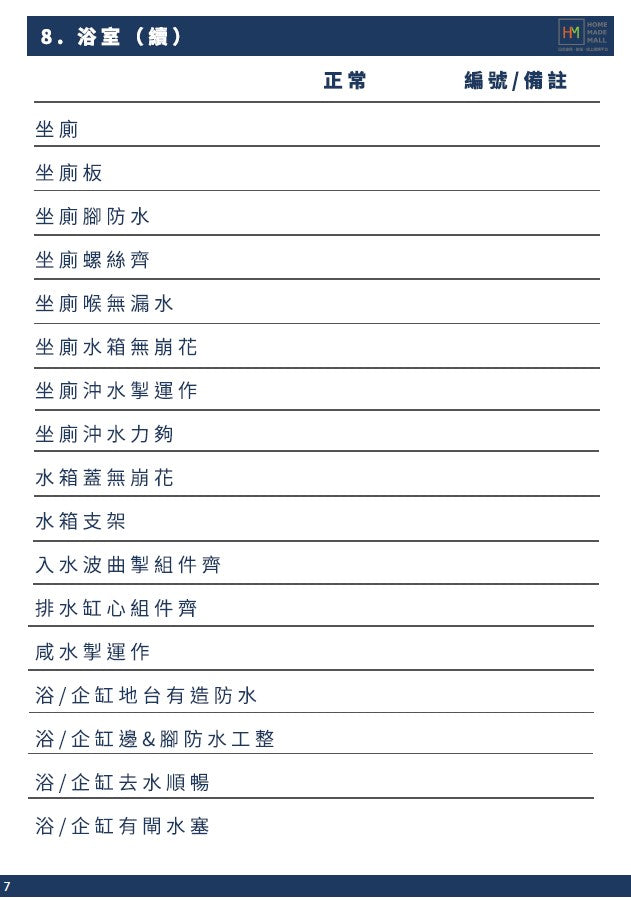
Super detailed inspection checklist, download and print now!
Homemade Mall has compiled the following detailed inspection checklist for new homeowners, so they can print it before the handover day and "follow the recipe" to inspect their new home step-by-step.